Rwanda’s Nyungwe Forest National Park may not get as much attention as the Volcanoes National Park – home to the rare mountain-dwelling gorillas – but it’s no less impressive.
Spanning more than 1,000 sq kilometres, wandering through Nyungwe Forest is ideal for travellers seeking a classic wilderness experience or those who merely want to clear their heads of clouded thoughts.
Located in southwestern Rwanda at the border with Burundi, Nyungwe is said to be the largest and best preserved montane rainforest in the whole of East and Central Africa.
The forest protects more than 1,000 plant species, at least 120 butterfly species, 310 bird species, 13 primate species and 38 reptile species – according to the Rwanda Development Board, the state-run agency in charge of the country’s flora and fauna.
Attractions in Nyungwe Forest
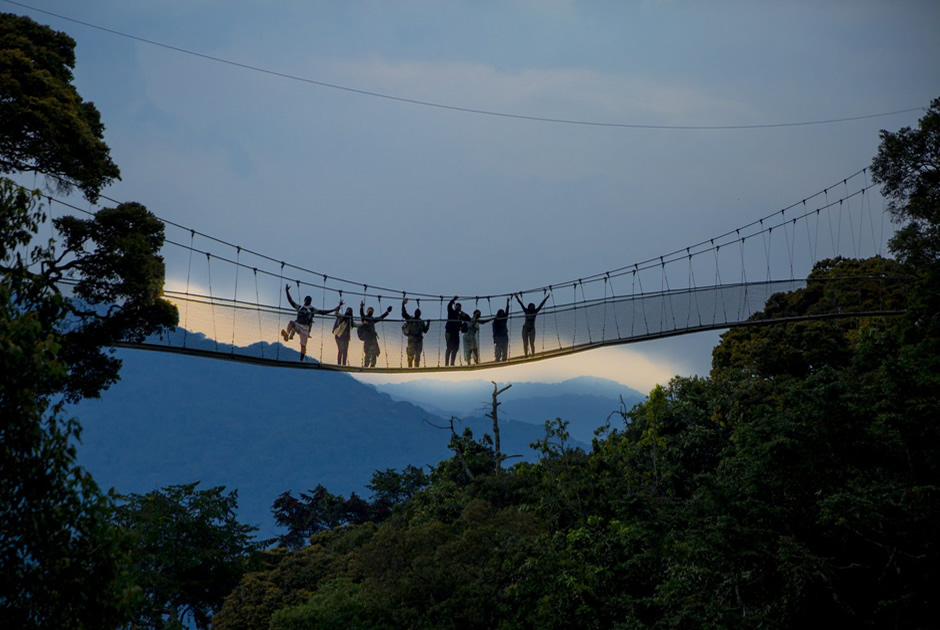
Nyungwe Forest National Park’s star attraction has always been the chimpanzee, followed closely by the Black & White Colobus Monkey, birdlife, as well as the only canopy walkway in East Africa, which spans 160 metres and rises 70 metres above the forest floor.
In my case, however, the primary motivator for my recent visit to Nyungwe Forest National Park was simple: to get back to nature and leave all the emotional baggage behind.
I was with a group of travel bloggers and journalists from around the world. We travelled to Rwanda on a media familiarisation trip sponsored by the Rwanda Development Board in the run-up to the 2018 installment of Kwita Izina, the country’s annual baby gorilla naming and conservation fete.
We visited Nyungwe Forest National Park on our third day in the country after checking out Kibuye, Rwanda’s tranquil vacation town that nests on the shores of Lake Kivu, one of Africa’s Great Lakes.
After our car pulled into the Gisakura Station on the western edge of the park, we were warmly welcomed by one of the park’s guides who, after a few hellos, gave us some commentary on Nyungwe.
The park is named Nyungwe because, many years ago, locals believed that leopards were roaming the forest. Nyungwe, we were told, means “the place of leopards” in Kinyarwanda.
The Rwandan government gazetted the forest in 2005 because of its outstanding natural value as it contributes significantly to the survival of both people and wildlife in the country.
“This forest is the source of 70 per cent of Rwanda’s water,” our guide said as we set off for our first hike in the forest.
Isumo Waterfall Trail
We pursued the path that leads to the Isumo Waterfall, located about five kilometres from One&Only Nyungwe House, the newest luxury lodge in the park.
Our mid-morning hike seemed quite comfortable at the beginning, and everyone in our group of 21 was enjoying it – or so it seemed. But it became a little unnerving for some of my colleagues as we progressed deeper into the forest.
The snaking Isumo Waterfall Trail, as it turned out, is the most strenuous hike in Nyungwe as it takes you through some steep ravines interspersed with slippery stretches.
But if you are under 70 years old, have two legs and a set of lungs and also exercise (even if it’s once in a while), this is not the kind of hike that should intimidate you.
Yet it did intimidate many of my colleagues. We were about two kilometres into the excursion when two of them began to complain of knee pain and decided to do an unprecedented about-turn.
The rest of us carried on, enjoying the forest’s cool breeze, the sound of streams, the breathtaking views of trees – many of them endangered species – blanketing every vista, as well as a bit of camaraderie.
There were also a couple of birds and Black & White Colobus Monkeys that we saw in the forest. Snakes such as vipers are also common here, our guide said, but thank God we never saw any slithering towards or past us. They loomed large in my mind, nevertheless!
As we clocked more kilometres on the trail, the air became thicker — perfused with smells of foliage — and most of my colleagues could no longer hide their increasing exhaustion.
“How long is it before we reach the waterfall?” they inquired at some point, almost in unison. Our guide averted another possible wave of about-turns when he informed us that we had only about 200 metres to the finish line. There wasn’t so much left to endure.
A few minutes later, there it was in front of us – nature at its most rudimentary. We couldn’t have imagined the beauty of the view. The less eulogised Isumo watery wonder quickly became the centre point of our trek, and we all agreed that the strenuous hike was worth it, after all.
We now focused on readjusting to our new surroundings and congratulated ourselves by depleting our packed lunch as we enjoyed the thunderous sound of the waterfalls.
For me, the tiredness slipped away instantaneously (well, almost) and my heart rate took the much-needed dip. I felt rejuvenated.
Canopy walkway
The following morning, we went for the canopy walkway trek on the eastern part of the park, and it turned out to be an easier ramble for all of us.
In fact, Nyungwe Forest’s canopy walkway took us only about one-and-a-half hours to complete, offering us nothing more than the spectacular views of the park’s landscapes.
A couple of hours later, we were back in our 4WDs for our return journey to Kigali. And as the lush green landscapes of Nyungwe Forest slowly blended into villages and then towns, we all felt reinvigorated and ready to re-enter the helter-skelter urban life and the air-conditioned world of Kigali Serena Hotel.
Leave a Reply